
Difference between Albert Einstein, Isaac Newton and Stephen Hawking
n
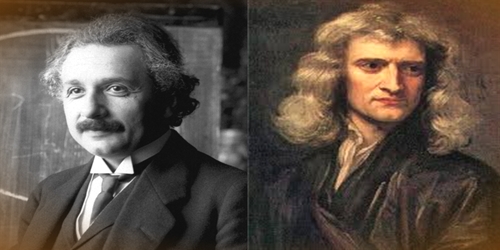
think about science, these personalities instantly come to mind, i.e., Einstein, Newton, and Hawking. They are mainly known for their space and time concept. Well! It’s a universally debated topic which of the two is more genius and intelligent. To know who they are? And what are the differences lying between them? Let’s move to the difference between Einstein, Newton, and Hawking.
Isaac Newton
Newton was born on 25 December 1642 and died at the age of 84. He never married. Newton is renowned for his work in the field of Optics, the three laws of motion, mechanics, and calculus, and as a Mathematician. He gave three laws of motion, which are still in use without any amendment. He was a genius, I must say. And he also gives the concept of Gravitational Pull.
Albert Einstein
Albert Einstein was born on 14 March 1876 and died at the age of 76. He has three children, and he is known for his work in philosophy and physics. He was inspired by Issac Newton.
Stephen Hawking
Stephen William Hawking was born on 8 January 1942 and died on 14 March 2018 at the age of 76. He was a theoretical physicist, cosmologist, and author of many books and formulae. He was the director of research at the Center for Theoretical Cosmology at the University of Cambridge. He was also a Lucasion Professor of Mathematics from 1979 to 2009.
What does their Physics Say? (Concept of Time & Space)
- Newton, Einstein, and Hawking talked mainly about the relationship between time and space, but with varying points of view. For Newton, time and space are absolute; they are unchangeable. Space is boundless, static, free from any complexity, and empty. Time is in an unstoppable flow since the birth of man. Time is constant.
- Here, Einstein says time and space are bounded. For him, time and space are completely twisted into one another, making one absolute truth. According to the motions of energy and matter, time and space are being shaped.
- Hawking discussed general relativityand quantum mechanics in his book ‘A Brief History of Time’. He proposed that black holes emit radiation and later evaporate. This gives the notion that black holes existed at the micro level since the Big Bang. He gave the no-boundary principle, which held that space and time are finite and the laws of physics determine how the universe began in a self-contained system. The real time shrinks if the size of the universe shrinks, but it will never reach a definable starting point.
Views on the Laws of Motion
- For centuries, people were curious to know the motion of planets and stars. Here, Newton gave a meaningful explanation through his theory of gravity. For him, gravity is a force that is carried by a universal medium called luminous ether. His concept perfectly explains the law of motion, which is entirely accepted.
- Here, on the other hand, Einstein was the opponent of Newton and abolished the concept given by him. By merely observing the effect of the twisting of space and time by matter, he inspected two situations. Resting on the surface of a massive body and accelerating in space. If the rate of acceleration was correctly adjusted, a person would feel the same downward pull of gravity. Einstein declared that the effects were the same.
- Hawking, in his book ‘The Theory of Everything’, advocates that the universe was created due to the laws of physics. The Big Bangwas inevitable because of the laws of gravity and force. The universe can and will create itself from nothing.
A Through Move to their Scientific Approach!
- For Newton, Mass and energy were different things. Space and time were other things.
- On the other hand, for Einstein, Mass and energy were interchangeable, i.e., E=mc2. Space and time were interchangeable. This is totally opposed to the theory given by Newton.
- Hawking, in his work Hawking Energy, says that mass is a measure of the bending of ingoing and outgoing rays of light that are orthogonal to a 2-sphere surrounding the region of space whose mass is to be defined.
Notable works
- Isaac Newton is known for his theories such as Newtonian Mechanics, Calculus, Principia, Optics, Binomial Series, Universal Gravitation, etc.
- Albert Einstein gave his thesis on ‘A New Determination of Molecular Dimensions’. Some of his famous works are: General Relativity, Special Relativity, Photoelectric Effect, E=mc2, Brownian motion, Cosmological Constant, Unified Field Theory, Ensemble Interpretation, etc.
- Stephen Hawking wrote many books and solved various equations. Some of them are: Hawking Radiation, A Brief History of Time, Penrose-Hawking Theorems, Bekenstein-Hawking Formula, Thorne-Hawking Preskill Bet, etc.
Timeless Minds, Modern Impact: How Newton, Einstein & Hawking Still Shape Our Future
In the 21st century with AI and quantum computing shattering frontiers, the inheritance of three science giants; Isaac Newton, Albert Einstein, and Stephen Hawking, is more relevant than ever.
Newton, also known as the father of classical physics, taught us his laws of motion and gravity. But today, what’s wonderful is how his principles of motion are still used in navigating spacecraft. NASA missions would not be possible via Newtonian physics to launch satellites into orbit and travel to other planets. His legacy isn’t behind us, it’s out of this world.
Einstein, whose General Relativity upset science on its head, still guides next-gen technology. GPS on your phone wouldn’t function properly without Einstein’s time-dilation adjustment for gravity from the planet. In a time of precision, autonomous vehicles, interstellar travel Einstein’s ideas aren’t “theoretical”; they’re functional prerequisites.
Stephen Hawking, who passed away in 2018, left behind ideas that scientists are still struggling to untangle. His theory of Hawking Radiation is powering the existing research in quantum gravity and black hole thermodynamics. With the 2019 photograph of a black hole and the introduction of quantum computing, Hawking’s vision of reconciling relativity and quantum mechanics is closer than ever.
What unites these legends isn’t just brilliance, it’s their refusal to give up questioning. In an age when technology is evolving more quickly than ever before, it’s these age-old questions—about motion, space, time, and life that ground science.
From hunting for Mars to building AI and quantum computers, Newton’s, Einstein’s, and Hawking’s fingerprints are on our future.
Which One is more Useful in this 21st Century?
Surely, it’s a worthy discussion. Well, concluding the whole debate and comparing works of these gems, we can easily comment that Einstein’s laws are minor in global eyes but Newton’s laws are still in the practical use. Today, in universities, colleges, schools everywhere, it’s of great use and essential. The work which is done by Newton in optics is now widely used, which includes real and virtual images through which glasses are made. It’s simpler to use in practical work. However, to understand the universe, it’s not lying in the ordinary experience but in the extraordinary experience. The most significant difference we can see is that Newton’s gravity is a force acting over a distance on objects. But for Einstein, gravity is not a force but how gravity works. Indeed, it’s not a complete answer but a worthy one to explore and understand the whole universe. Hawking’s works and theories are significant for science because he gave ground-breaking theories like Hawking Radiation, the Black Hole debate, Big Bang, and the Theory of Everything that are still to be researched.
So, what are your thoughts on these great personalities?

Einstein work in philosophy and physics , these both are totally difference field of study
After the death of Einstein, it was considered that Einstein theory is more relevant than Newton. But with the passage of time, there was a confusion. Now a days Newton is considered more correct than Newton. However both of them done a great job and make a revolution in the physics.
Nice piece of information