
Difference between William Wordsworth, Samuel Coleridge and Robert Southey
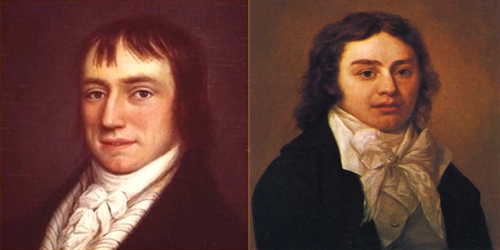
Literature is so vast that it is full of dramatists, novelists, and poets. In the Romantic era, a group of poets came forward. The similarity between them was their love for nature. Among these Romantic poets were the ‘Lake poets’. They were called so because they were born in the Lake District of England. They were William Wordsworth, Samuel Taylor Coleridge, and Robert Southey.
In this article, we will do a comparative study of these poets that are primarily and closely related to the romantic period of the 19th century. This post will reveal the difference between William Wordsworth, Samuel Taylor Coleridge, and Robert Southey.
William Wordsworth versus Samuel Coleridge versus Robert Southey
A glimpse of the French Revolution and the Romantic Era
When we look at a review of the life of these romantic poets, we see that their lives were highly influenced by the French Revolution. When machinery, lives, literature, religion, church, society all were in vain, and people started finding their identity; in this state of agony, nature was also destroyed, and these poets beautifully picked up the subjects of nature so that they can become close to the nature.
How can we Find a Significant Difference between these Poets?
Well, when we talk about Coleridge, he thinks that nature is something that is to be preserved. Basically, in his poem, ‘The Rime of the Ancient Mariner’ and ‘Kubla Khan’ , he portrayed nature as something mysterious, full of fantasy and an imaginative source of happiness as he says, “Nature is something which leads you towards fancies.”
On the other hand, when it comes to Wordsworth, his poetic imagination is so vast that one could get baffled about what’s going on. He is famous for his famous “Lyrical Ballads”.
William Wordsworth studied the simple objects of nature and gave them the imaginative colors. It wasn’t his business to make excursions in the world of supernaturalism. It was left to Coleridge to introduce the world of supernaturalism, mystery, and magic in poetry in this way. Wordsworth liked to give to the objects of Nature, the colour of his imagination. At the same time, it was left to Coleridge to make the supernatural natural.
Robert Southey was a friend of Samuel Taylor Coleridge and William Wordsworth. He produced literature unremittingly- poetry, criticism, history, biography, journalism, translations, and editions of earlier writers. He, along with Coleridge, wanted to form a “Utopian Community” in Pennsylvania in the United States.
A Comparison of Poems:
William Wordsworth was a nature worshipper and lover. In “Prelude,” he defines nature as mother, a guide, a sister, and a peaceful soul. For him, man is destroying nature as he is a social animal by nature. He is supposed to preserve nature, but he himself is ruining it day by day. Wordsworth’s poems can be apprehended through various steps, like starting from physical delight, which leads you towards mental delight, and finally, the stage of spirituality comes and knocks on the door of mankind.
In contrast, when we glance at Coleridge’s work ‘Kubla Khan’ , which is famous for its vivid imagery, imaginary mountains, a castle, and splashing water, which is beyond reality.
And also ‘The Rime of the Ancient Mariner‘ is all related to the description of a man, who had killed the bird Albatross and is bearing the consequences that nature is giving him. He shows how nature takes its revenge. He has demonstrated spirits, vivid imagery, and drowsiness. Here, the element of drowsiness is vital as whatever he is writing is in the state of unconsciousness as if he were under the influence of Opium.
Robert Southey can be referred to as ‘Underdog’ because his poetry is hard to get into and is sometimes compared to Wordsworth and Coleridge. Southey’s works are concentrated on the common man, equality of all people, and the abolition of slavery. His poetry favored the everyday speech of the day. One of the most applauded works of Southey was ‘The Battle of Blenheim‘. The theme of this poem is the futility of war.
Notable Works
William Wordsworth notable works are mentioned as follows:
- Lyrical Ballads-1798
- The Prelude-1799
- I Wandered Lonely as a Cloud-1807
- Lines Composed a Few Miles Above Tintern Abbey-1798
- The Excursion and the Recluse-1814
- The World is Too Much With Us-1807
- The Solitary Reaper-1807
- We are Seven-1798
- Peter Bell-1819
- Guide to the Lakes-1810
- The White Doe of Rylstone-1815
- Resolution and Independence
- Yarrow Revisited-1835
- An Evening Walk
- The Idiot Boy-1798
- The Borderers
- The Tables Turned
- Michael-1800
S.T.Coleridge’s notable works are mentioned as follows:
- The Rime of the Ancient Mariner-1798
- Kubla Khan-1816
- Christabel-1816
- Dejection-An Ode-1802
- Confessions of an Inquiring Spirit-1840
- Fears in Solitude
- Lyrical Ballads-1798
- Sibylline Leaves-1817
- Anima Poetae-1895
- The Fall of Robespierre-1794
Robert Southey’s notable works are mentioned as follows:
- Goldilocks and the Three Bears-1837
- Thalaba the Destroyer-1801
- Curse of Kehama-1811
- Madoc-1805
- A Vision of Judgement-1821
- Joan of Arc-1796
- Letters written during a short residence in Spain and Portugal-1797
Nature’s Trinity: The Distinctive Voices of the Lake Poets
It was here in England’s Lake District that three great revolutionary poets emerged to recreate Romantic literature in terms of their close sympathy towards nature. The Lake Poets, i.e., William Wordsworth, Samuel Taylor Coleridge, and Robert Southey, all had very different philosophical and poetical conceptions of the world of nature.
William Wordsworth had faith in nature being the spiritual guide and moral teacher of humankind. His theory of “emotion recollected in tranquility” transformed poetry by discovering deep meaning in everyday, common things. William Wordsworth’s “Lyrical Ballads” made poetry popular with ordinary folks by employing everyday language to communicate universal truths.
Samuel Taylor Coleridge penetrated the supernatural, mysterious character of nature with imagination and dreamlike imagery. In opium-induced dreams, his fantasies produced haunting masterpieces such as “Kubla Khan” and “The Rime of the Ancient Mariner.” Coleridge’s “willing suspension of disbelief” theory became a standard in literary criticism.
Robert Southey, frequently overshadowed by his more famous contemporaries, concentrated on humanitarianism and social justice in his orientation. His poetry urged everyday citizens and protested the senselessness of war, as in “The Battle of Blenheim.” His children’s fairy tale “Goldilocks and the Three Bears” endures in modern culture.
Their cooperative camaraderie was the dream of Romantic ideals of sight and artistic unity. Wordsworth contributed unshakeable moral substance, Coleridge poetic brilliance, and Southey social consciousness. Together, they created the Lake District as England’s poetry center.
Contemporary environmental poetry benefits from the philosophy of nature. Their insight that industrialization endangered human spirituality concerning nature is relevant to our climatically sensitive era. The Lake Poets demonstrated that regional identity could be universalized in the sense of actual art.
What to say now?
Concluding, we can say that, Wordsworth was a poet who loved nature as the creation of God. He could feel a soul, a friend, a guide, and a true companionship in nature. So, he was a poet who kept secondary imagination as it also provided the soulful effect of a nature. On the other side, Coleridge was a poet who was totally different from him. His primary imagination worked in the state of unconsciousness. Wordsworth’s steady nature and moral preoccupations affected Coleridge’s wavering will and rambling tendencies. Yet, Wordsworth could not stop the decline in Coleridge’s poetic power, but one can say that their contribution to English was a landmark produced during the Romantic period in English poetry.
Who is your favorite poet among these?

hi
Hi
i am a student of literature and linguistics…. woild you like to communicated me or you how? send me some thing good about english criticism and philosophy.
I am also literature student.you complete postgraduate
difference is elaborated in a good manner.
you are welcome. Thanks
hi,i’m a student of English and literature,I always find your post very helpful in My research and also 4 assignment purposes,thumbs up.
Its great you are welcome.
Yes this whole data about both posts are really informative and helpful for me.
grateful to you your appreciation.