
Difference between Sunni, Shia and Khawarij
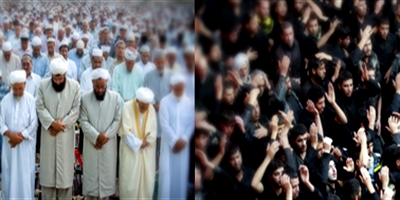
Islam, as a religion, is divided into some fundamental branches. Three of these branches are: the Sunnis, Shia, and Khawarij. This division begins in a debate not long after the passing of the Prophet Muhammad over who ought to lead the Muslim community. The dominant part of Muslims are Sunnis –estimates propose the figure is somewhere around 85%. The number of Shia reaches from 120 to 170 million according to estimates, approximately one-tenth of all Muslims. Individuals from the two groups have existed together for a considerable time and share numerous basic practices and beliefs. In this article, we will discuss the distinctions between these fundamental branches of Islam, i.e., Sunni, Shia, and Khawarij.
Sunnis
Sunni Muslims view themselves as the customary and traditionalist branch of Islam. The word Sunni originates from “Ahl al-Sunna”, the people of tradition. The word tradition here alludes to practices taking into account point of reference or reports of the activities of the Prophet Muhammad (ﷺ) and those near him. Sunnis adore every one of the prophets specified in the holy book of Muslims, QURAN”, yet especially Muhammad (ﷺ) as the last prophet. All subsequent Muslim pioneers are seen as transient figures. As opposed to Shia, Sunni religious instructors and leaders have truly gone under state control. The tradition of Sunnis additionally underscores a systematized arrangement of Islamic law and obedience to four schools of law.
Shia
As per early Islamic history, the Shia was a political group, truly “Shiat Ali” or the gathering of Ali (R.A). The Shia asserted the privilege of Ali (R.A), who was in law of Prophet Muhammad (ﷺ), and his relatives to lead the Islamic group. Ali (R.A) was murdered as an after-effect of the common wars which defaced his caliphate. His son named Hassan is accepted to have been harmed by Muawiyah, the first caliph (pioneer of Muslims) of the Umayyad administration. His second son, Hussein, was murdered in Karbala. These events lead to the idea of grieving and martyrdom. There are extensive Shia groups in Afghanistan, Kuwait, India, Lebanon, Qatar, Pakistan, Syria, Saudi Arabia, Turkey, and the UAE.
Khawarij
The khawarij is also called kharijites and ash-shurah. It is a section of Islam that appeared in the first century of Islam during the First Fitna, i.e. the crisis of leadership after the death of the Prophet Muhammad. It came up with a revolt against the authority of Caliph Ali. A khawarij later assassinated Ali. Thus, the Khawarij became a source of insurrection against the Caliphate for hundreds of years to follow. The only surviving section of the khawarij are the Ibadis.
Sunni vs. Shia vs. Khawarij
The distinctions among these three lie in the fields of principle, custom, law, philosophy, and religious association.
Number of people
- There are almost 1.2 billion people in the world called Sunni.
- There are about 200 million people in the world named Shia.
Successors after Muhammad(ﷺ)
- There are the four rightly guided Caliphs according to beliefs of Sunnis: Abu Bakr, Umar bin Al Khattab, Usman bin Afan, and Ali bin Abi Talib.
- There are twelve reliable Imams of Shia, which are: Ali bin Abi Talib, Ali ZainulAbideen, Hussain, Hassan, Jaafar AlSaadiq, Ali ZainulAbideen, Muhammad AlBaqir, Musa AlKaazim, Ali AlNaqi, Ali AlRaza, Hasan AlAskari, Muhammad AlTaqi, and Muhammad AlMahdi.
Opinion about Imams
- According to of Sunnis, imams are seen unexpectedly. Imams are frequently important religious leaders in the group, yet they are not seen as faultless and are not revered upon death, as happens to imams in Shia Islam.
- In Shia beliefs, imams are taken as religious leaders picked by Allah and free from sin. They are immediate descendants of Prophet Muhammad (ﷺ).
- Khawarij believed that any Muslim could be an Imam as long as he abided by al moral values. The people were allowed to stand against the Imam in case he sinned.
Place of worship
- For Sunni, the mosque and Eidgah are the places to worship of ALLAH (S.W.T).
- For Shia, the places reserved for worship are imambargah or ashurkhana, mosque, and eidgah.
Temporary marriage
- According to Shia beliefs, temporary marriages called nikah mut’ahare allowed.
- In Sunni Islam, there is no concept of temporary marriages, and they consider it a great sin.
Places most associated with faith.
- The places that are most associated with Sunnis and they have a strong feelings to visit that places are Makkah and Medina.
- The places which Shia have more affiliation with are Kufa and Karbala.
Beliefs
- Sunnis have a strong belief on the five pillars of Islam that are Shahadah, prayer, zakat, fasting, and pilgrimage.
- Shia’s have beliefs on the five main pillars of Islam, but in addition to they have their five more unique faiths.
- Khawarij believes in the doctrine of free will. Any act of sinning results in disbelief and make the sinner kafir. A kafir has to repent for his sins to become a Muslim again.
Majority
- Sunnis are mostly present in Muslim countries, and others are living around the world.
- Shia are present in Iraq, Iran, Yemen, Lebanon, Azerbaijan, and Bahrain in large numbers and little number are living across the world.
- Khawarij has only one surviving section-Ibadis. They are located in areas of Oman, Algeria, Tunisia, Libya, and East Africa.
Mourning
- In Sunni Islam, mourning or self-beating is not allowed by any scholar, as it is considered a great sin.
- To honor the suffering of Hussein, Shia gatherings walk in enormous parades on the tenth day of the Muharram month. There is self-beating i.e., flagellating own back, hands on chest, blades, cutting edges, or chains. This is allowed by a few scholars in Shia Islam.
Beyond Doctrine: Modern Influence and Geopolitical Impact
Although theological disputes between Sunnis, Shias, and Khawarij extend back to the very beginning of Islamic history, contemporary geopolitics provides a decisive new level of meaning to such divisions.
Sunnism, supported by an immense world majority, controls religious organizations in most countries that have significant Muslim populations. However, it is not homogeneous. Salafism, that Sunni movement of reform favoring a return to past Islamic traditions, has affected new movements, at least to some extent, whether these were violent or non-violent. It does so, most notably in the Gulf States, where Saudi-led Wahhabist Salafist dominance pervades state-sponsorship religious theology.
Shia Islam, historically disenfranchised in Sunni-majority countries, has evolved into a force for sociopolitical change. Shia clerical authority was politicized with the Iranian Revolution of 1979 to produce an authority of a ruling group that gave birth to the theory of Wilayat al-Faqih (Guardianship of the Jurist), whereby clerics occupy seats of political authority. The model helps to shape Shia militias and political trends in Iraq, Lebanon (e.g., Hezbollah), and Yemen.
The Khawarij, whom historians tend to identify as extremists in early Islamic times, have largely died out save for the Ibadi branch. Although the Khawarij are remembered as being strict and having bloody uprisings, Ibadism has become tolerant and pragmatic Islam. Contemporary Ibadis, primarily in Oman, preach non-violence, tolerance, and consensus through voting to determine leadership, far removed from their past reputation.
To understand these communities today is no longer theology, it’s politics, identity, and international power. Sectarianism today is less of a religious ideology and more of a matter of power dynamics, foreign policy, and identity politics within the Muslim world.
Conclusion
From the above discussion, we come to know that some of the beliefs of the Shia community are not supported by any Sunnah and not accepted by Sunni. Khawarij or Ibadis came into existence circa 650 CE. This section predates both Sunni and Shia denominations.

what is the difference between corporation and incorporation?