
Difference between General Pervez Musharraf and General Raheel Sharif
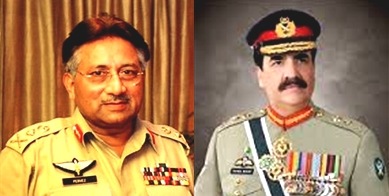
A steady majority rule government, solid common organizations, an autonomous legal and full-grown media are a few percentage of the key elements for the achievement in the conclusive war against terrorism and radicalism.
Both generals tried their level best to serve the country in their way so this article presents the differences that exist between these personalities.
General Pervez Musharraf
Pervez Musharraf is a Pakistani government official and a retired four-star rank armed forces general who served as the tenth President of Pakistan from 2001 to 2008.
Pervez Musharraf was born on 11 August 1943 to a Urdu-talking family in Delhi, India, four years prior to independence. He is the child of Syed and Zarin Musharraf. Musharraf’s first youth home was called Neharwali Haveli. The home’s title deeds were composed altogether in Urdu, aside from his dad’s English signature.
General Raheel Sharif
General Raheel Sharif is a four-star rank armed force general and the current (fifteenth) Chief of Army Staff of the Pakistan Army, in office since 2013. General Raheel Sharif was born on 28 June 1956 in Quetta. He fits in with a respectable Rajput family with roots in Punjab.
He has a notable military background. He is the child of the late Major Rana Muhammad Sharif. His eldest sibling, Major Rana Shabbir Sharif, was awarded the Nishan-e-Haider after his death in the Indo-Pakistani War of 1971. His other sibling, Captain Mumtaz Sharif, also bravely served in the Pakistan Armed Forces, and for his courage, he was granted the Sitara-e-Basalat. He is also the nephew of Major Raja Aziz Bhatti, who received the Nishan-e-Haider in the Indo-Pakistani War of 1965 from Pakistan.
Pervez Musharraf VS Raheel Sharif
Below are the some differences among Pervez Musharaf and Raheel Sharif:
| Aspect | Pervez Musharraf | Raheel Sharif |
| Army chief | Pervez Musharraf served as the thirteenth army chief of Pakistan for nine years, from October 6, 1998, to November 28, 2007. | Raheel Sharif is serving as the fifteenth chief of army staff of Pakistan. He joined on November 29, 2013, and has been working to date. |
| President | Pervez Musharraf also served as the tenth president of Pakistan for eight years, from 2001 to 2008. | Raheel Sharif did not serve as the president of Pakistan. |
| Chief executive of Pakistan | Pervez Musharraf served as the chief executive of Pakistan from October 1999 to November 2002. | Raheel Sharif did not serve as the chief executive of Pakistan. |
| Minister of Defense | Pervez Musharraf worked as the Minister of Defense for three years, i.e., October 1999 to October 2002. | Raheel Sharif did not work as the Minister of Defense. |
| Chairman of staff committee | Pervez Musharaff renders his services as chairman of the Joint Chiefs of Staff committee for two years, i.e., October 1999 to October 2001. | Raheel Sharif did not render any service as chairman of staff committee. |
| Political party | Pervez Musharraf has a keen interest in politics. First, he joined the Pakistan Muslim League Quaid, and then he established his political party in 2010, named the All Pakistan Muslim League. | Whereas Raheel Sharif have no interest in politics and he did not join any political party. |
| Belonging | Pervez Musharraf basically belongs to a middle-class family in Delhi, India. | Raheel Sharif belongs from Rajput family in Punjab. |
| Background | Pervez Musharraf’s father works in the Foreign Office of the Indian government, and his ancestors also served the Indian government. | Raheel Sharif has a military background as his father, uncle, and brothers served in the army. |
| Children | Pervez Musharraf has two children, including one daughter and one son. | Raheel Sharif has three children, including two sons and one daughter. |
| Age | Pervez Musharraf is 72 years old. | Raheel Sharif is 59 years old. |
| Years of service | Pervez Musharraf rendered his services for 43 years, i.e., 1964- 2007 | Raheel Sharif has rendered his services for more than 30 years |
| Unit | Unit of Pervez Musharraf is the Army Regiment of Artillery. | Unit of Raheel Sharif is the 6th FF Regiment. |
| Commands | Pervez Musharraf’s commands include I Corps, XII Corps, the Special Services Group, DG Military Operations, and the 40th Army Division in Okara. | However, Raheel Sharif commands the XXX Corps and is the XI Division Commandant at PMA Kakul. |
| Books | Pervez Musharaf wrote a book titled “In the Line of Fire: A Memoir.” | Raheel Sharif writes no book. |
| Lectureship | Pervez Musharraf delivers the lecture on political science at different universities. | Raheel Sharif did not deliver any lecture at the university level. |
| Views | According to the perspectives of the British and many other politicians, the era of Musharraf is not considered a good time for Pakistan. | The views on Raheel Sharif are very positive, as what he accomplished in two years cannot be achieved in 8 to 10 years. He has conducted many successful operations against those who have hostile intentions toward Pakistan. |
Two Generals, Two Legacies: Pervez Musharraf vs. Raheel Sharif
General Pervez Musharraf and General Raheel Sharif were two of Pakistan’s most well-known military leaders, but their careers and legacies were quite different.
Pervez Musharraf held both military and political authority. He became Chief Executive and later the President of Pakistan after leading a coup in 1999. He served as army chief for nine years and took on various political roles, such as Minister of Defense and Chairman of the Joint Chiefs of Staff Committee. Musharraf’s tenure was marked by mixed reactions, on one hand, economic reforms and modernization, and on the other, political disasters like the Lal Masjid operation and the imposition of emergency rule.
Raheel Sharif, on the other hand, never ventured into politics. He remained strictly oriented towards the military and was widely respected for his command of counter-terror operations. During his tenure, Pakistan launched Operation Zarb-e-Azb in 2014, a significant military operation against militant strongholds in North Waziristan. His leadership restored some public trust in national security and helped earn him accolades for being politically neutral and results-driven.
Musharraf had a diplomatic background, while Raheel came from a highly decorated military heritage. This shaped their leadership styles. Musharraf aimed to personally drive both foreign and domestic policy. In contrast, Raheel preferred to operate behind the scenes, letting his actions, particularly military victories and enhanced civil-military relations, speak for themselves.
Interestingly, Musharraf wrote a memoir, In the Line of Fire, and gave international lectures after his retirement. In contrast, Raheel, being more introverted, kept a lower profile and accepted a high-ranking position as commander-in-chief of the Islamic Military Counter Terrorism Coalition following his retirement.
Essentially, Musharraf was a politician turned soldier. Raheel Sharif was a soldier until his death. One was led into politics by control, the other by battlefield strictness.
Conclusion
From the above discussion we come to know that Pervez Musharaf is more experienced than Raheel Sharif but later have done his best for Pakistan.

General Pervaiz Musharraf ,abrogated constition of Pakistan of Pakistan and must be trailed along with abettors as per article No 6 of constitution of Pakistan . Contrary General Raheel Sharif, has obtained approval from National Assembly for years period to establish military courts to combat terrorists in Pakistan. This is great difference with two Generals in fact.
Musharraf was more courages & daring.He took our the command of Pakistan when he felt & abserve that civil govt.is not properly managing the affairs of the country.The same is the position now a days but more worst.The HIGH RANK OFFICIAL & THE POLITICAL LEADERS in the GOVT are looting the sources & funds of the country with both hands & there is NO check on their illicit activities.Mr.Ishaq Dar the close relative of C.M have invented many ECONOMIC tricks to loot the country wealth such as SUBSIDIARY/FOREIGN LOANS/THE WORST DECLINE IN the rate of mark up etc for creating funds for corrupt stakeholders.They are the GREAT terrorists.Mr.Raheel belongs to the family of secrificers so he must also snubs & give physical punishment to such terrorists also
This was written by a very biased person (implied few things) and let me little biased too lol…
Every one who has last name “Shareef” or “Sharif” we should be cautious – Corruptions is always very hide thing….
No body COMPARE Mushraf with any one he was really intellegant and brave I think raheel sharif is good man but not intellegant like mushraf
Mustaf is intelligent and brave raheel sharif is good but I think no one beat mushraf he did good for Pakistan
How he did good for Pakistan and Raheel Shareef Joined KSA forces after 2 month of retirement what do you think about it?