
Difference between Aristotle and Plato
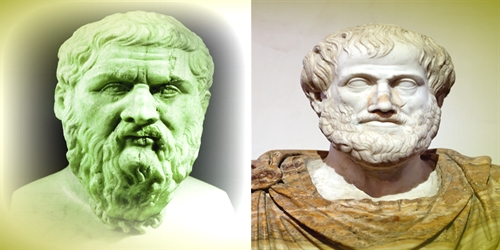
When we look back at the Greek times, forenames like Socrates, Aristotle, Plato, and many other philosophers instantly come to mind. In the history of mathematics and philosophy, Aristotle, and Plato both worked a lot.
Plato
Plato was born circa 428 B.C. in Athens and got education under Socrates. His notable works are: Theory of Forms, Platonic Idealism, and Platonic Realism.
Aristotle
Aristotle’s expected date of birth is 328 B.C to 384 B.C in Stageira, Chalcidice. He was a renowned philosopher, writer, teacher, and mathematician. Under Plato, he learnt a lot. His notable works are: The Golden Mean, Reason, Logic, Biology, and Passion.
Aristotle Vs Plato
| Aspect | Plato | Aristotle |
| Relation | Aristotle and Plato had the relationship of a teacher and student. Naturally, it is expected that the student will follow their teacher. Aristotle followed Plato, but with a different perspective. They both focused on human nature and its functions as their major projects and developed philosophies around these topics. | Similar to Plato (a student of Plato), but developed different perspectives. |
| Sketch of Art | In his book, Republic IX, Plato states that art is the imitation of the world. It’s a complete reflection of the actual picture, misleading the minds of people. The theory of imitation and the theory of forms are closely examined in it. | Art is undoubtedly an imitation in which an artist expresses their creativity. Therefore, he admired art more than his mentor Plato. He held a different perspective on art compared to his teacher because he valued it more highly. |
| Vision on Soul | The soul guides the body and mind; it is compared to a chariot driven by two horses at a time. The soul is divided into emotion, desire, and reason. True knowledge is gained through reason, and the soul is a part of reality. | Human thinking can be inactive and creative. One aspect addresses the physical needs of man and the body’s mortality, while the other encompasses the spiritual side of the soul, which will return to God. |
| Negation of Functionality Views | The perfect form of ethics, morals, and character cannot be achieved. Even with the contribution of society as a whole, perfection remains unattainable. | “Injustice is the dominant power over justice.” Injustice can never develop an ideal state; human function plays a vital role. A person’s character, actions, attitude, and knowledge shape an ideal society. |
| Philosophy of Reaching Pleasure | True happiness can be attained through genuine virtue, strong character, and love for God. It requires a collective societal effort that emphasizes moderation, self-control, and sincere love for God. | Focus on individual happiness. True happiness can be achieved when a person fulfills the functions of living and practices virtues. |
| Views on Ethics | Wisdom was the basic and most important virtue. It encompasses all virtues and can be taught through knowledge. Telling someone the difference between right and wrong leads to virtue. Philosophy was theoretical. | Wisdom was a virtuous goal that required effort and diligence to achieve. It didn’t appear automatically or unify other virtues. Happiness is built on virtues and supported by social constructs. This provided practical insight. |
| Contribution to Science | He wrote about mathematics, geometry, and physics in a theoretical and exploratory manner. His works on biology and astronomy did not contribute anything new to existing knowledge. | His writing was practically applicable. Considered one of the first true scientists. Developed scientific observation method, contributed to math, physics, zoology, botany, and astronomy (geocentric model). |
| Achievements | Known for expertise in philosophy and mathematics, he believed in unity and taught its importance. He was also regarded as a spiritual teacher. | Contributed to zoology, physics, and poetry; inventor of the classification system still in use; had a great love for music. |
Aristotle vs. Plato: Minds That Shaped the Western World
Two of the greatest Western philosophers, Plato and Aristotle, founded the basis for almost all scholarly fields from metaphysics and ethics to politics and science. While Plato’s student Aristotle later founded a whole other worldview, they have become irrevocably intertwined in Western tradition.
Plato (c. 428–348 BCE) was heavily influenced by his instructor Socrates. He established the Academy in Athens, the first known Western university. At the center of Plato’s thought is his Theory of Forms, which holds that real reality lies outside the physical world. He was convinced that the senses are deceptive and only reason has access to eternal truth. In his greatest works, such as The Republic, he imagines a society that is egalitarian and ruled by philosopher-kings leaders who are guided by wisdom and virtue.
Aristotle (384–322 BCE), who was a student of Plato, ruled out the Theory of Forms. He believed that reality exists in the physical world and must be learned from observation and reason. He founded the Lyceum, where he promoted empiric study and classified knowledge. Aristotle’s “Theory of the Golden Mean” to find a middle point between extremes is still a pillar of ethical philosophy today.
Plato in science favored mathematical abstraction, while Aristotle established biological classification, marine animal studies, and formal logic, which is the foundation of computer science today.
Though Plato regarded art as a perversion of truth, Aristotle prized it for its emotional understanding and catharsis. In politics, Plato advocated elitist governance by the wise, whereas Aristotle advocated constitutional governance under law and with a powerful middle class.
Their inheritances continue, Plato influenced idealism and religious philosophy; Aristotle powered scientific inquiry and applied ethics. Combined, they influenced centuries of questioning, debate, and discovery.
Conclusion
Aristotle and Plato appreciated art with different perspectives, gave different philosophies on human functioning, happiness. Their motive was the same: to develop a good sense of reasoning in people.
Who was better in your opinion?

Leave a Reply